How a Dental Oral Appliance Helps with Sleep Apnea
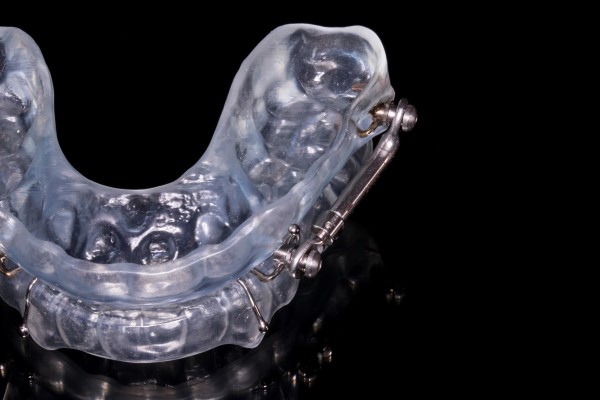
An oral appliance is one of the treatment options for sleep apnea. Many patients prefer this type of device because they are more comfortable than wearing a mask and that they are portable and can be moved around easily. It is a convenient and less-invasive way to treat the symptoms of sleep apnea. Continue reading to learn more about how an oral dental appliance works for sleep apnea.
How oral appliances for sleep apnea work
The device fits over the upper and lower teeth, in a similar way to a dental retainer. It works by moving and retaining the tongue and jaw in a forward position to prevent them from blocking the airway even if the muscles of the air passages relax completely during sleep.
The upper and lower sections are linked with a piston and tube, which only limit how much the jaw retrudes. As soon as the muscles relax while in a deep sleep, the tubes lower and the chin is held forward. The airway will remain open throughout sleep so that the patient can continue to breathe normally.
Points to consider with oral appliances
An oral appliance is meant for mild to moderate cases of sleep apnea only. For patients with severe sleep apnea, an oral device may not be advisable as the support may not be adequate for compromised air passage. The dentist may also recommend oral appliances so that a patient can tolerate the CPAP machine better.
After about two to six months of using the device, the jaw should have advanced considerably. At first, the appliance will slightly shift the lower jaw forward, and as patients get familiar with this and their jaw muscles relax, the dentist will increase the tension. The process is done gradually to reduce the risks of side effects. By the end of the adjustment phase, the dental appliance will be fully optimized for sleep apnea treatment.
Getting a dental appliance
There are various suppliers of oral devices on the internet. These devices are relatively inexpensive but are usually not effective for sleep apnea treatment. They are not custom-fit, and poor fitting oral devices can cause teeth movement and potential tooth loss. It is advisable to visit a dentist that has experience providing the dental appliance. The dental professional will perform an important assessment to know whether the device will be effective for treating sleep apnea.
When the patient visits the dentist, they will have impressions or molds of their teeth taken. With the impressions, the dentist will recreate a plaster replica of the patient’s bite and perform preliminary fitting to see how effective the mandibular advancement devices will be. If the patient cannot move their jaw forward properly, the treatment may be ineffective.
Final note
An oral appliance can be a practical and efficient solution for treating snoring and sleep apnea. It is vital that you visit an experienced general dentist and ensure that the device is fitted and adjusted regularly.
Request an appointment here: https://columbiadentaloffice.com or call Columbia Advanced Dental Studio at (410) 635-5105 for an appointment in our Columbia office.
Check out what others are saying about our services on Yelp: Sleep Apnea in Columbia, MD.
Related Posts
Caring for a child's teeth is essential to their overall health. Pediatric dental care focuses on keeping smiles healthy, preventing common dental problems, and ensuring children develop good oral hygiene habits early. From routine checkups to specialized treatments, pediatric dentists offer a range of services designed to protect teeth and gums while making visits to…
If you or a loved one has a dental abscess, then you need to visit an emergency dentist as soon as possible to ensure the infection does not spread to the rest of the mouth. A dental abscess causes more than a simple toothache, and delaying care may increase the risk of serious complications. As…
Crown lengthening is the practice in periodontics of exposing the teeth to provide a stable base for a new prosthetic crown, correct a gummy smile, or access cavities or perforations under the gum line. There are several methods to achieve this, with some being more invasive than others. Let us explore the procedures available today.Lengthening…
A denture reline is a normal part of wearing dentures. Relines are needed to fix ill-fitting dentures. You experience bone loss when you wear dentures, and eventually, that will cause the dentures to fit poorly. The reline adjusts the shape of the dentures, so they fit once again. Most people need a reline every two…